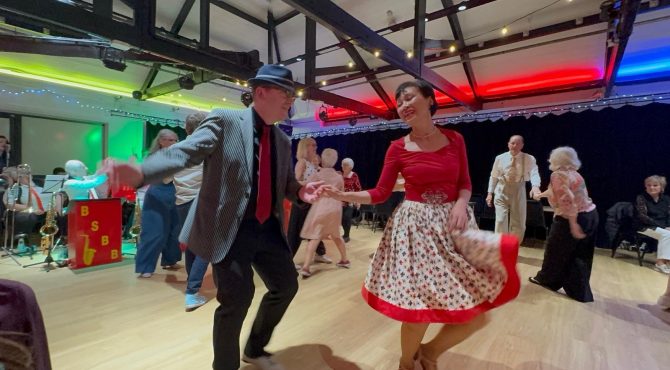
At Lindy Jazz, we aim to make learning to dance a simple and joyful process.
Sometimes, though, when we are new to dancing – or simply new to learning something unfamiliar – it is very easy to overcomplicate things.
We can start watching everyone else, checking and assessing whether we are doing exactly what they are doing, worrying about whether we are doing it right, trying to listen to every instruction, and even attempting to solve problems that are not ours to solve.
So let’s make this simple.
How do I know whether to lead or follow?
It depends on whether you are new or experienced, and what you want from your dancing.
If you are new, choose one role and focus on learning that set of skills.
If you are experienced, you may enjoy trying the opposite role to deepen your understanding of the dance.
And whichever role you choose, you do not need to worry about balancing the numbers in the class. Your teachers have already planned for that.
Leading and following feel very different
In Lindy Hop, we dance in lots of different ways. Sometimes we dance on our own, sometimes as a group, and sometimes with a partner.
When we dance with a partner, we use two different sets of skills: leading and following.
They can feel very different.
A leader is learning how to communicate movement clearly, comfortably and in time with the music.
A follower is learning how to listen through the connection, respond to what is being led and still bring their own movement and musicality to the dance.
Neither role is linked to gender.
Anyone can lead and anyone can follow.
If you are new, focus on one role
When you are at the beginning of your dancing journey, we recommend choosing either leading or following and concentrating on that role.
During class, you will often hear two sets of instructions – one for leaders and one for followers.
You do not need to take in both.
If you are following, listen for the follower instructions.
If you are leading, listen for the leader instructions.
Trying to listen to both can make something simple feel much more complicated.
So give yourself permission to focus on just one job.
You can always explore the other role later.
You don’t need to balance the class
You are coming to Lindy Jazz to be a student – not a teacher, organiser or problem solver.
If you look around and see lots of people of one gender, please don’t assume they are all dancing the same role.
And please don’t think:
“There are too many followers. I’d better lead.”
Or the other way around.
If you change role simply to try to solve what looks like a numbers problem, you may end up making the class more confusing for yourself and for others.
You don’t need to fix anything.
Your teachers have already planned exercises so that everyone stays involved, everyone gets plenty of dancing and everyone has a chance to work on their own skills.
You won’t be left with nothing to do simply because the numbers do not match.
So choose your role and relax.
We’ve got the rest covered.
Choose your role and stay with it for the class
At the beginning of the session, decide whether you would like to lead or follow and, as far as possible, stay with that role for the class.
We know that people sometimes swap because they are trying to be helpful.
But changing roles partway through a session can cause confusion for you and for the people dancing with you.
There will always be another class.
You can follow this week and try leading another week.
Or you may decide that you really enjoy one role and want to keep developing it.
Both are absolutely fine.
If you are experienced, try the other side of the dance
Once you have plenty of experience in your usual role, learning the opposite role can give you a much fuller understanding of Lindy Hop.
If you normally lead, learning to follow helps you understand what it actually feels like to receive a lead.
You begin to notice how much difference timing, clarity, comfort and connection make.
That can help you become a better leader.
If you normally follow, learning to lead gives you a very different appreciation of how clear a lead needs to be.
You experience how timing, direction and confidence affect how easy something is to follow.
That can help you become a better follower.
So learning the opposite role is not simply about collecting more skills.
It allows you to experience the dance from both sides of the partnership.
If you have been dancing for a couple of years or more, a beginners’ class can be a lovely place to explore the opposite role at a comfortable pace.
You certainly do not have to.
But if your goal is to understand the dance more deeply, it can be enormously useful.
Your partner is learning too
One of the lovely things about Lindy Jazz is that we are all learning together.
That means your partner will not be perfect.
And neither will you.
A leader may not lead something in exactly the way you have experienced elsewhere.
A follower may not respond exactly as you expected.
That is part of learning.
Rather than trying to correct or teach your partner, concentrate on your own dancing and on the exercise your teachers have given you.
What can you notice?
What can you practise?
What can you make a little clearer, easier or more comfortable?
Your teachers are there to do the teaching.
That leaves you free to enjoy being the student.
Trust the simple building blocks
Sometimes the exercises we give you may not immediately feel like “proper dancing”.
There is a reason for that.
We build your dancing gradually.
You might begin with a rhythm, a foot pattern, movement on your own or a very simple partner exercise.
Be patient with those building blocks.
You do not need to rush ahead or work out the whole dance.
Just do the exercise in front of you.
Then do the next one.
Week by week, those pieces begin to join together.
Your movement becomes more natural.
Your leading or following becomes clearer.
And suddenly you realise…
You’re dancing.
By Week 6, you may find yourself dancing through a whole song using far more rhythms, movements and ideas than you imagined you could learn in such a short time.
That is the Lindy Jazz magic
So keep it simple.
If you are new, choose one role and focus on it.
If you are experienced, consider exploring the other role.
Choose your role at the start of class and stay with it.
You do not need to balance the room or solve any problems.
Focus on your own learning, trust the process, and enjoy the dance.
We’ll take care of the rest.