Social dancing is not about proving how much you can do.
It is about enjoying the music, connecting with another person, looking after yourself, and finding ways to adapt.
This is especially important when the weather is hot, the room temperature is high, you are feeling tired, or the music feels too fast. There is always a way to make the dance work for you.
You Don’t Have to Dance The Whole Song
One story comes to mind.
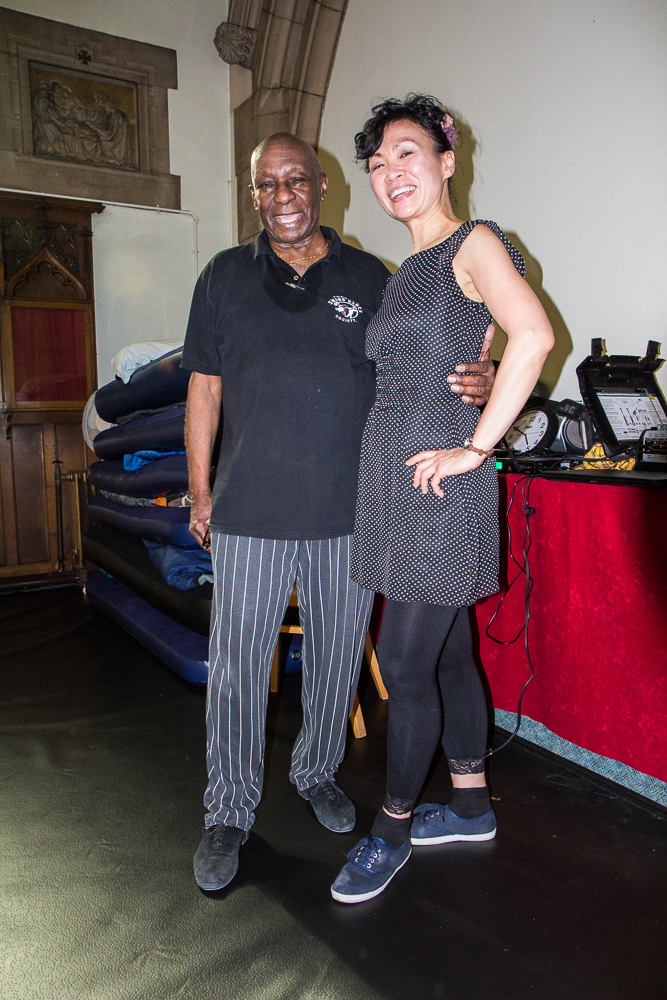
Many years ago, I had the pleasure of dancing with Charles ‘Chazz’ Young, son of the legendary Frankie Manning. Chazz was in his 80s at the time, and after travelling and teaching a full day of workshops, he showed such wisdom in how he paced himself.
At the time, Chazz was in his 80s. He had travelled some distance to the event, taught during the day, and was still there in the evening, enjoying the music and the company.
When I asked him to dance, he said something very simple and very wise.
“Just wait for a bit, and we’ll dance partway through the song.”
I have never forgotten that.
There was no fuss. No apology. No need to explain. He simply knew how to pace himself.
How to Adapt When the Music Feels Too Fast
That is such a valuable lesson for all social dancers, especially if you are newer to Lindy Hop.
You do not have to start dancing at the very beginning of a song.
If you love the music but it feels too fast, you can wait and join in halfway through. You can even dance the last part of the song. A short dance can still be a joyful dance.
Keep It Simple When the Room Is Hot
If the room is hot, you can keep your movements smaller. You can choose simpler steps. You can leave out the turns. You can take a break. You can say yes to one dance and no to the next. You can enjoy watching, listening, clapping along, or chatting with friends.
That is all part of social dancing too.
Sometimes dancers feel they have to keep going from the first beat to the last, but that is not true. Experienced dancers often know how to adapt. They listen to their bodies, read the room, feel the music, and make sensible choices.
Dancing well is not always about doing more. Sometimes it is about doing less, but doing it with ease, confidence and enjoyment.
Finding Fun Ways to End a Dance
In this week’s Lindy Jazz classes, we will be exploring this idea in a practical and playful way. We will look at how to adapt during hot weather and how to enjoy the dance without overdoing it.
We will also be looking at different ways to identify the end of a song and create a fun ending.
Different Types of Song Endings
Not every song finishes in the same way. Some songs have a clear, abrupt ending. Some fade out. Some have a false ending where you think the music has finished, but it starts again. Some have an extended ending that gives you time to play, pause, pose, or simply enjoy the final few beats.
Learning to hear these different endings can help you feel more confident on the social dance floor. It also gives you more choice. You do not have to panic when the music changes. You can listen, respond, and have a bit of fun with it.
Social Dancing Is About Choice, Not Pressure
So, if you are dancing in hot weather, feeling tired, or facing a song that feels a little too fast, remember Chazz’s wise example.
Wait a little.
Join in when you are ready.
Dance part of the song.
Keep it simple.
Enjoy the music.
Social dancing is not about pushing through. It is about adapting, connecting and finding joy in the moment.
And sometimes, the best dance is not the longest one. It is the one that leaves you smiling at the end.
What do we mean when we ask Lindy Hop dancers to relax?
It is not about doing nothing. It is about releasing tension, feeling safe enough to learn, and becoming more responsive, confident and connected on the dance floor.
When we say “relax” in a Lindy Jazz class, we do not mean collapse, switch off, go floppy, or drift through the dance with no energy. Lindy Hop needs energy. It needs rhythm, bounce, attention, connection and response. It needs you to be awake in your body and ready to move.
So what do we mean?
When we say relax, we mean letting go of the tension that is getting in the way.
That might be tension in your shoulders, arms, hands, jaw, knees or feet. It might be the little habit of holding your breath when something feels new. It might be gripping your partner’s hand because you are trying so hard to get the move right. It might be your brain shouting, “I’m going to forget this,” before you have even had a chance to try.
Relaxing does not mean being lazy
It means becoming available for learning.
Before a dancer can absorb new information, they need to feel calm enough to take it in. If you feel judged, rushed, confused or put on the spot, your body can become tense before the dancing has even begun. Then, instead of enjoying the music and noticing what is happening, you may go into survival mode.
You may start thinking:
“I should know this by now.”
“Everyone else is getting it.”
“I’m holding my partner back.”
“I’m going to mess this up.”
“Why can’t I remember the move?”
Those thoughts are very common, especially when learning partner dancing. But they do not help your body learn. In fact, they often make dancing feel harder.
A relaxed dancer is not a careless dancer. A relaxed dancer is more responsive, more aware and more able to enjoy the dance.
Relax Does Not Mean No Effort
This distinction is important.
Relax does not mean removing all effort from the dance. If you were completely relaxed, you would probably be lying on the floor having a nap. Lovely, but not very useful for Lindy Hop.
Dancing needs useful energy. It needs enough tone in the body to move clearly, enough attention to listen to the music, and enough presence to respond to your partner.
The aim is not to remove effort altogether. The aim is to release the effort that is not helping.
You might soften your shoulders while still keeping your rhythm. You might loosen your grip while still maintaining connection. You might stop overthinking the whole pattern and simply focus on the next step. You might take a breath and give yourself permission to learn one piece at a time.
Relaxation in dance is not about disappearing from the movement. It is about creating enough ease to notice what is happening.
Why Tension Gets in the Way
When we are tense, we often become less able to feel.
Our arms may become stiff. Our feet may feel heavy. Our timing may become rushed. Our partner connection may feel unclear. We may try to force the move instead of allowing it to work.
This is why we often remind dancers to soften, breathe, wait, listen, or try again more gently.
It is not because we want the dancing to become vague. It is because good dancing needs awareness.
When your body is tense, it becomes harder to receive information. You may not feel the lead or follow clearly. You may not notice the rhythm. You may not hear the music properly. You may miss the small details that would actually make the move easier.
A tense dancer often tries harder and harder.
A learning dancer learns to notice sooner.
Tension Is Not Always Bad
It is important to say that tension is not bad in itself.
In partner dancing, we use different amounts of tone, stretch, compression, energy and relaxation throughout a dance. As dancers become more experienced, they learn to use these different degrees with more choice and awareness.
Sometimes the dance needs more tone. Sometimes it needs more softness. Sometimes the connection needs to feel clearer, more elastic or more energised. Relaxing is not the only way to dance.
The problem is not tension itself.
The problem is unnecessary tension that blocks connection.
Very often, we tone our arms, especially our forearms, without realising. We may think we are relaxed, perhaps a 4 on a scale of 1 to 10, but our partner may be receiving something very different.
That is why awareness is so useful. Once we notice what we are doing, we have more choice.
A Simple Class Exercise: What Number Are You Giving Out?
One useful exercise we do in class is to explore grip and tension through a simple handshake.
We ask dancers to shake hands with a partner using different amounts of grip or arm tone. One person may offer a very light hand, then a firmer hand, then something much stronger. The other person notices what they feel.
Then we ask a simple question:
“On a scale of 1 to 10, how much tension did you feel?”
This is where things get interesting.
One person might think they are offering a gentle 4, while their partner experiences it as a 7. Another person might think they are being very clear and supportive, while the other person feels they are gripping too tightly. Sometimes the tension is real. Sometimes it is perception. Often, it is a mixture of both.
So we turn it into a game.
Try offering your partner what you think is a 3.
Then ask, “What number did you feel?”
Try offering what you think is a 5.
Then ask again, “What number did you feel?”
You may be surprised by the answer.
This is not about getting it right or wrong. It is about discovering how your connection feels to another person. In partner dancing, we are always communicating through touch, timing, rhythm and movement. We do not only need to know what we think we are giving. We also need to become curious about what the other person is receiving.
A good connection is not about being floppy, and it is not about being forceful. It sits somewhere in the middle, and that middle may change throughout the dance. There is enough tone to communicate, but enough softness to listen.
Relaxation Makes Dancing More Fun
The more relaxed and aware you become, the more you can enjoy the dance.
You begin to feel the rhythm rather than chase it. You begin to notice your partner rather than worry about yourself. You begin to enjoy the music rather than count every single step in panic.
Of course, there will still be moments of confusion. That is part of learning. Every dancer, including experienced dancers, has moments where something does not work.
The difference is that a relaxed learner does not treat every mistake as a disaster.
They simply pause, notice, adjust and try again.
That is how confidence grows.
So, What Do We Mean by Relax?
We mean:
Soften your shoulders
Breathe gently
Let your hands stop gripping
Let go of a strong tone in your forearms
Unlock the grip in your knees
Relax does not mean doing nothing. It means letting go of the tension that stops you dancing well.
It means keeping the energy that helps and releasing the effort that gets in the way.
It also means understanding that tension, tone and energy all have a place in dancing. The skill is learning when they help, when they block, and how they feel to the person dancing with you.
And most of all, it means remembering that you are not here to be perfect.
You are here to learn, dance, connect, laugh and enjoy the music.